
A founder once told me something that sounded responsible at first.
“I just need more control.”
Revenue was growing. The team had expanded. From the outside, the company looked successful. Inside the company, however, everything still ran through him. Every decision, every client issue, and every strategic conversation eventually came back to his desk. The team depended on him for answers because, as he explained, “no one else really sees the whole picture.”
At first this seemed like a sign of strong leadership. But over time something strange started happening. The company was growing, yet the organization was not. More people were hired and more work was done, but the founder felt more overwhelmed than ever. The business had expanded, yet its ability to function without him had barely changed.
At one point he said something that revealed the real problem.
He had assumed that growth meant having more control.
In reality, growth usually requires the opposite. It requires understanding what you can truly control, what you can only influence, and what you must grow into over time. Two simple models help explain why this distinction matters so much for leadership, followership, and strategy.
The Circle of Control
The first model is the Circle of Control. It helps clarify where responsibility actually belongs.
At the center are the things you directly control. These include your behavior, your preparation, the standards you set, and the decisions you make. For leaders, this might include how clearly roles are defined, how meetings are structured, and how consistently expectations are enforced. For followers, control often appears in the form of ownership over tasks, communication, preparation, and the quality of execution.
Surrounding this inner circle is the circle of influence. Here outcomes cannot be forced, but they can be shaped. Influence grows through credibility, consistency, competence, and trust. Leaders influence the culture of their teams, the direction of conversations, and the willingness of others to take responsibility. Followers influence upward as well, strengthening decisions by raising concerns, sharing insight, and improving the quality of information inside the organization.
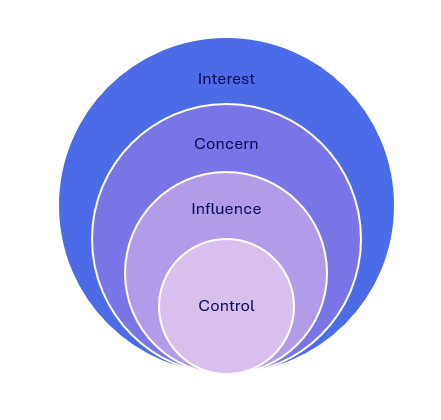
Beyond influence lies the circle of concern. These are things that matter deeply but cannot yet be influenced directly. Market shifts, competitor behavior, regulatory changes, and technological disruption often sit here. Strategic thinkers pay close attention to this circle, not because they can control it, but because it signals where future opportunities and risks may emerge.
Finally, there is the circle of interest, the broad field of ideas, news, and signals that surround every organization. Much of this information will never affect the organization directly, but occasionally something from this outer ring moves inward and becomes strategically relevant.
The mistake many leaders make is simple: they behave as if everything belongs in the center circle. They attempt to control markets, control people, and control outcomes that cannot actually be controlled. This creates frustration and drains energy that should be focused on execution and influence.
Yet even when leaders understand these circles intellectually, another barrier often prevents real growth.
The Comfort of Control
The place where we have control is also the place where we feel most competent. It is familiar territory. We know the systems, we understand the rules, and we can predict the outcomes of our actions. In other words, the center circle often overlaps with what we call the comfort zone.
This psychological dynamic explains why many individuals and organizations struggle to expand their influence. Leaving the comfort zone introduces uncertainty. Suddenly mistakes become possible. People worry about appearing unprepared or losing credibility. Doubt creeps in, and excuses become easier to justify.
For this reason, growth rarely happens automatically. To understand why, it helps to look at a second model.
The Journey Beyond Comfort
The comfort zone model describes the psychological journey required for development. At the center lies the comfort zone itself, where tasks feel safe and predictable. Just outside it is the fear zone, where self-doubt appears and people begin to worry about failure or criticism.
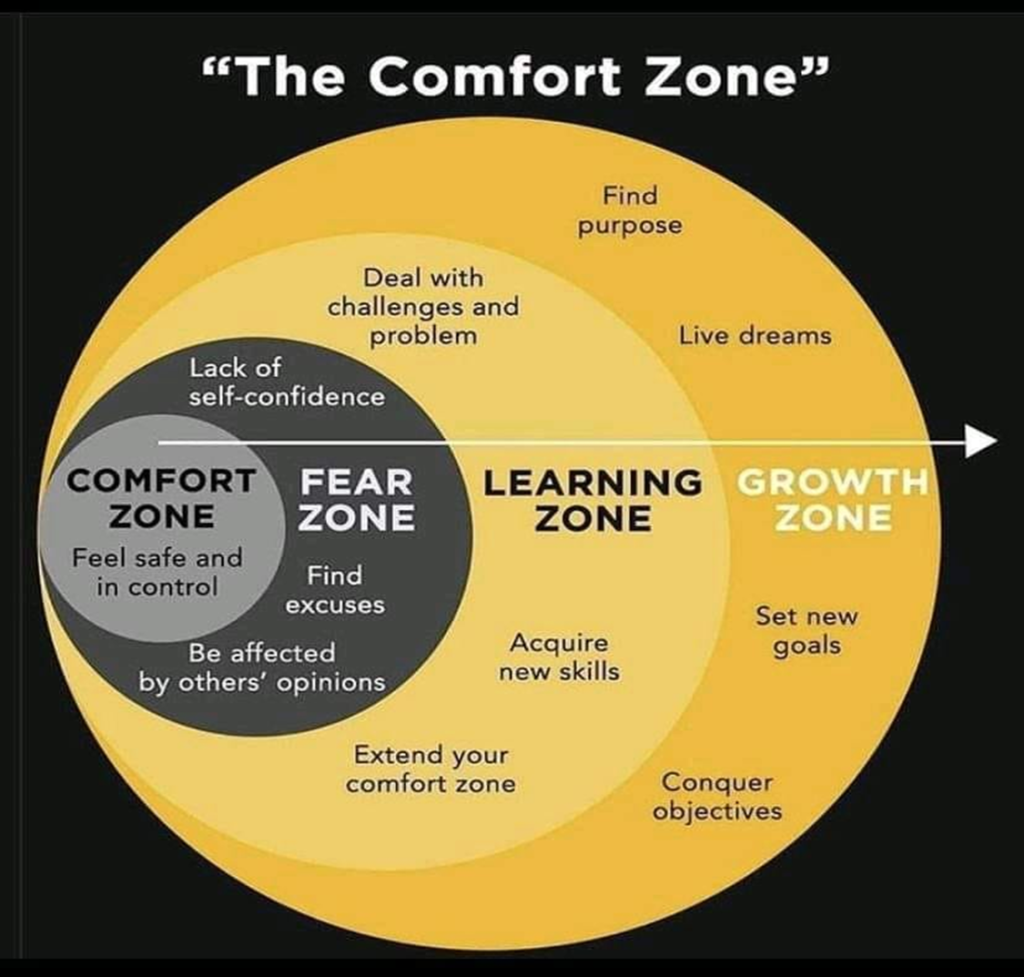
Many individuals and organizations stop at this point. They retreat back to familiar routines and convince themselves that staying safe is the responsible choice. As a result, the organization continues operating, but its capabilities remain largely unchanged.
If someone pushes past that fear, however, they enter the learning zone. Here new skills are acquired, new responsibilities are tested, and problems that once felt intimidating begin to become manageable. This is the space where genuine development takes place.
Eventually, sustained learning leads to the growth zone. In this stage individuals and teams pursue larger goals, operate with greater confidence, and begin shaping outcomes that once felt beyond their reach. This is the stage where organizations begin to scale their impact.
What makes this journey challenging is that growth requires stepping into areas where control is initially limited.
Where the Two Models Meet
When we place these two models side by side, an important insight emerges.
The Circle of Control explains where our responsibility lies. The Comfort Zone model explains why expanding that responsibility often feels uncomfortable. Growth requires both discipline and courage. Leaders must remain focused on the things they truly control while simultaneously encouraging movement into areas that require learning and adaptation.
This is where leadership and followership intersect. Leaders create environments where people feel safe enough to experiment, learn, and take responsibility beyond their current capabilities. Followers contribute by stepping forward rather than retreating into familiar territory.
Over time, this process produces a powerful effect. Skills improve, systems mature, and trust deepens across the organization. As this happens, tasks that once felt uncertain gradually become manageable. Areas that once sat outside the circle of control begin to move inward, expanding the organization’s influence.
Strategy as Expansion
This leads to a different way of thinking about strategy. Many people assume that strategy is primarily about planning. While planning is important, it does not by itself change what an organization is capable of doing.
Strategy is ultimately about expanding the range of things an organization can reliably influence and eventually control. That expansion happens through learning, experimentation, and the willingness to move beyond comfort.
Organizations that understand this dynamic become stronger over time. They continue executing well within their circle of control while deliberately building the capabilities that allow their influence to grow.
Organizations that avoid this process often remain busy but stagnant. They protect their comfort zone and spend energy worrying about things outside their control, without developing the capabilities required to change them.
Growth begins when leaders and followers alike recognize that control is not the final destination. It is simply the starting point from which influence, learning, and strategic capability expand.